What we count, and what we don't.
We try to measure honestly. Numbers on this page reflect the Foundation's direct programming and direct investments, not the broader Stanford courses, MOOCs, or research that our co-founders contribute to in their professional capacities. Where we don't yet have data, we say so.
500,000+ entrepreneurs reached globally, through a small set of long, evidence-led partnerships rather than broad grantmaking.
Our programming concentrates on SDG 4 (Quality Education), SDG 8 (Decent Work and Economic Growth), and SDG 10 (Reduced Inequalities). Individual investments name the SDGs they advance on the portfolio page.
How we got here.
Filed January 31, 2021. The Foundation grew the way the work itself tends to grow, one long partnership at a time, mostly through former students and people we already knew.
- 2021January, founded
Paperwork filed. SFSU CS Mentorship launches as first university partnership.
Filed January 31, 2021, in the middle of the pandemic. The first program partnership was with San Francisco State University, Lijie's alma mater, standing up the SFSU CS Mentorship Program connecting Computer Science majors with alumni. First mission-related investments (Pow.bio, Natilus) made the same year.
- 2022December, MEETConf
Co-taught a full-day MEETConf workshop in Jerusalem with MIT MEET students.
December 17, 2022. Lijie and Chuck traveled to Jerusalem to co-teach a full-day workshop at MEETConf, MIT MEET's annual conference for current Israeli and Palestinian students and alumni. The day covered product management, computer science, design thinking, customer development, and the lean startup, across parallel development and product-management tracks. A single-engagement contribution rather than an ongoing partnership.
- 2023Operating model
Converted from non-operating to operating foundation. Tanzania program with LOHADA.
Two years in, we converted to an operating-foundation structure to match how we were actually working: directly running programs alongside long-term partners, not grantmaking from a distance. June 2023 brought the first Tanzania visit with LOHADA, co-taught with Abisola Kusimo and organized by former student James Juma.
- 2024Geographic expansion
Molokai GenCyber guest talk. Vietnam programming begins. Uganda refugee entrepreneurship work launches.
August 2024: Lijie guest-teaches the NSF-funded Molokai GenCyber high school cybersecurity program on careers in security and infrastructure engineering. December 2024: Vietnam workshops with Fulbright University, UEH, and an HKU/AWS partnership in Ho Chi Minh City, co-taught with former student Bao Phan. Same year, Uganda refugee-entrepreneurship work begins through the Stanford Impact Labs Faculty Design Fellowship, in partnership with Challenges Uganda and Makerere University Business School.
- 2025Scale through teachers
Molokai residency. Penang Science Cluster reaches ~2,500 students via a 100:1 multiplier. Eight active MRI/PRI positions.
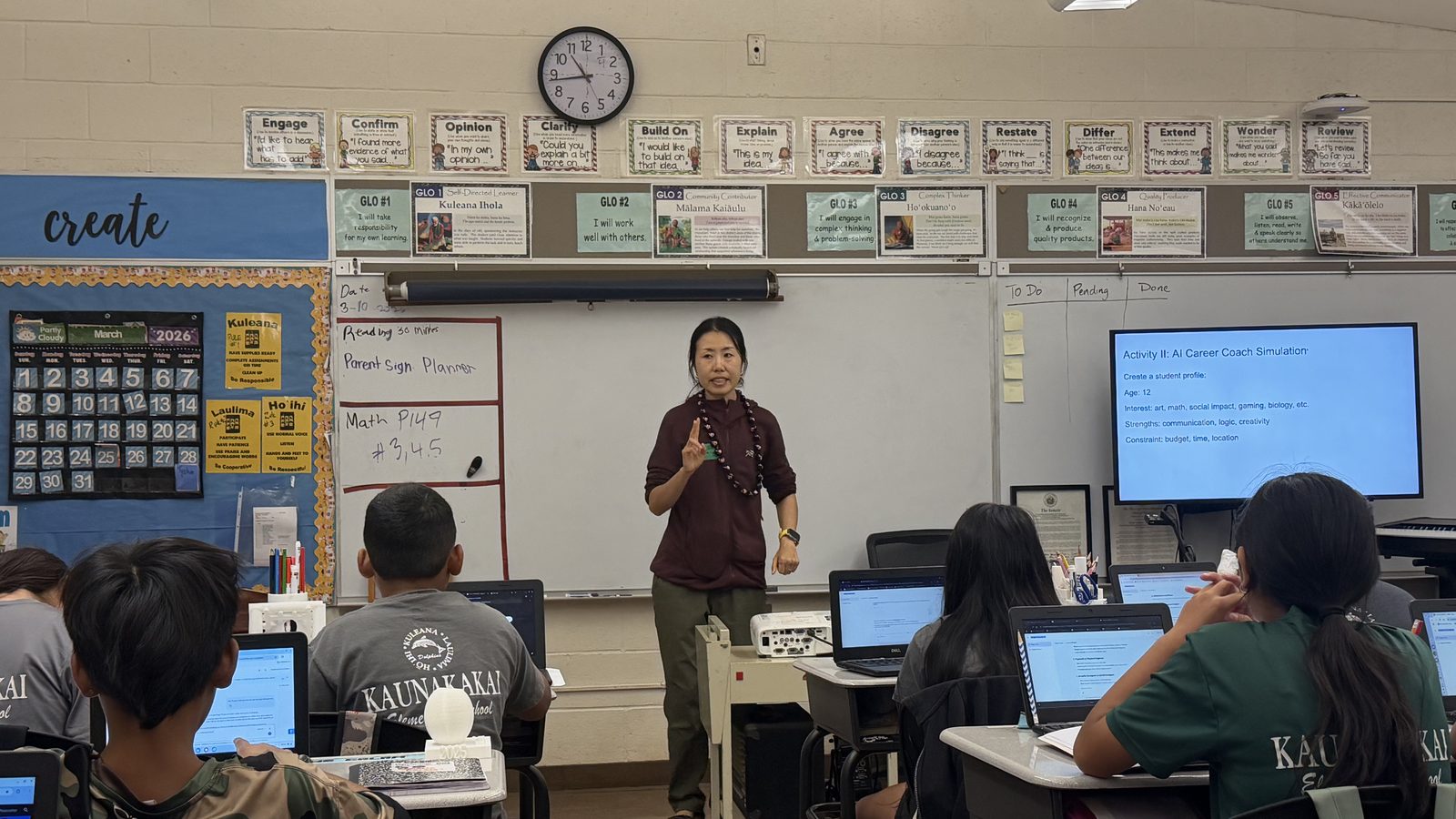
March 2025 residency at Kaunakakai Elementary on Molokai. December 2025 Penang teacher-training program: roughly 25 teachers trained, on the order of 2,500 students reached through a 100:1 per-teacher multiplier, the model we now benchmark against. Year-end: $1.89M in assets, 14% deployed into mission-related investments, eight active MRI/PRI positions across health, sustainability, and financial inclusion.
- 2026Evidence layer
Five-year mark. Project ASPIRAS AI launches. Uganda RCT scale-up. Return visit to Kaunakakai Elementary.
March 2026: return trip to Kaunakakai Elementary on Molokai, extending the entrepreneurship, career-planning, and applied-AI work begun in the March 2025 visit. July–October 2026: Lijie leads Project ASPIRAS AI, a four-month cohort program helping 15 Malaysian non-profits move past basic chatbot usage into deep operational AI integration, in partnership with MySDG Academy and APPGM-SDG under Malaysia's 13th Malaysia Plan; two of the four modules were delivered by August, each to more than thirty participants. July 2026: Chuck delivers a three-session educational series — on how innovation ecosystems are built, the path for Chinese founders going global, and the Stanford model of university entrepreneurship — for a Tianjin University student group hosted by Beta University, with students developing applications of AI to social-impact ventures tied to UN Sustainable Development Goals and National Academy of Engineering Grand Challenges. July 2026: the Foundation contributed Problem Statement 9, Accelerating AI Adoption for SMEs, to the NUS Enterprise Summer Programme in Entrepreneurship in Singapore, with a coaching session with Chuck as the winning team's prize; over 200 students from 20 countries built 40 ventures across the programme's briefs, and Team SMEily won ours. The contribution was remote, and NUSSP participants are not counted as Foundation students. December 2026: ten days of entrepreneurship teaching in Bangkok for high school and college students from underprivileged backgrounds, both co-founders instructing, coordinated by a former student now at Stanford. Uganda: 500+ refugee entrepreneurs trained to date. Active in-country programming and the planned RCT scale-up are temporarily paused mid-2026 in response to the Ebola outbreak in Uganda and the Democratic Republic of Congo; the alumni cohort remains active in their communities and the Foundation plans to resume with Challenges Uganda and MUBS when in-country engagement is safe. Co-founders mark five years with paired reflections; the work for the next five turns toward deeper teacher cohorts in places we already work, careful expansion only where there is a clear long-term reason to be there, and the kind of rigorous evaluation infrastructure that lets us tell honestly whether the work is moving outcomes.
Taiwan (2018) predates the Foundation as an ongoing partnership rather than a year-specific milestone. See the per-program reach below for the full picture.
Penang Science Cluster: a multiplier in action.
In December 2025, the Foundation ran a teacher-training and student-discovery program at the Penang Science Cluster in Malaysia, in partnership with the U.S. Embassy in Kuala Lumpur and APPGM-SDG. Roughly twenty-five teachers were trained directly. Across the cohort, the curriculum reached on the order of 2,500 students, a multiplier of roughly 100 students per teacher trained.
From early survey responses (six teachers, eleven students): every responding teacher adopted AI tools or design thinking techniques in their classroom, every responding teacher reported saving one to five hours per week through AI workflow integration, and 73% of surveyed students reported discovering a career path they had not seriously considered before.
Before joining this workshop, I felt unsure and unclear about my future career direction… This workshop gave me the opportunity to explore my interests and skills more deeply, and helped me see how they can be applied in ways that are beneficial not only to myself, but also to society.
ChatGPT helps me design lesson plans, generate discussion questions, and create differentiated learning materials… which saves time and allows me to focus more on student engagement.
Where the work happened.
Cumulative reach across each program's lifetime. Brackets ([TKTK]) mean we have programming but haven't yet finalized the count; a dash (, ) means a category is not applicable for that program.
| Program | Students | Teachers | Schools |
|---|---|---|---|
San Francisco State University The Foundation's first university partnership, launched during the pandemic. Helped stand up the SFSU CS Mentorship Program connecting current Computer Science majors with alumni for mock technical interviews and career guidance. First-cohort alumni have since returned as mentors (one is now an engineer at Google). Foundation's direct involvement has since wound down; the program continues today under SFSU and its alumni network, the model the Foundation hoped for. | , | , | 1 |
Malaysia (Penang) 2025: roughly 25 teachers trained, reaching on the order of 2,500 students across their classrooms. Early survey responses from 6 teachers / 11 students show 100% teacher AI-tool adoption, 73% of surveyed students discovering new career paths. Capstone session Dec 30, 2025 at the American Tech Corner @ PSC (morning Stanford-design-thinking workshop on PSC internal workflows; afternoon AI career-exploration clinic for 15 students + AI masterclass for teachers and staff). | ~2,500 | ~25 | multiple |
Malaysia (Kuala Lumpur) Talks at Universiti Teknologi Malaysia (faculty conversations) and Parliament (APPGM-SDG). | ~20 | ~30 | , |
Project ASPIRAS AI (Malaysia, 2026) 4-month cohort program (July–October 2026) helping 15 selected Malaysian non-profits move past basic chatbot usage into deep operational AI integration. Led by Lijie Zhou. Four modules covering AI foundations + PDPA-compliant responsible use, prompt engineering for impact, operational AI & productivity, and communications & fundraising. Part of the Mainstreaming the 3rd Sector for Social Economy initiative under Malaysia's 13th Malaysia Plan (RMK 13). | , | , | 15 non-profits |
Tanzania Direct teaching plus teacher-training cohort at LOHADA. | ~50–60 | ~20 | 1 |
Vietnam Programming across 2–3 events with Fulbright Vietnam, UEH College of Business, and the HKU/AWS workshop. | ~30–40 | ~20 | 3 |
Molokai March 2025 residency with teacher Kawika Gonzales. | ~20 | 1 | 1 |
Taiwan Two middle schools, ITRI helped organize. June 2018, a pre-Foundation engagement that later became a Foundation partnership. | ~75 | , | 2 |
MIT MEET Single-engagement teaching contribution at MEETConf, December 2022. | ~80 | , | 1 |
Uganda 500+ refugee entrepreneurs trained to date; 65% of businesses in initial cohorts are women-led. Microloans of $500–$1,000 disbursed to top performers via Challenges Uganda; curriculum and research with Makerere University Business School. Early RCT findings indicate refugee mentors significantly improve idea quality, particularly for women. Active in-country programming and the planned RCT scale-up are temporarily paused as of mid-2026 due to the Ebola outbreak in Uganda and the Democratic Republic of Congo; the alumni cohort remains active and the Foundation plans to resume with Challenges Uganda and MUBS when in-country engagement is safe. | 500+ | , | , |
Paris (France) July 2025: Foundation supported Prof. Sylvain Bureau's Improbable Chair seminars at ESCP, Improbable AI & AI (executives + Stanford students, July 22) and Improbable Equality (organizations and students working on equal opportunity in France with partner L'Ascenseur, July 23). Chuck taught and mentored pro bono and joined the closing panel "Lost in Translation: Between Artistic and Artificial Intelligence" at the Musée Postal. Single-engagement contribution; relationship open to deepening. | , | , | , |
Beyond the headcount.
Reach matters, but it's not the same as impact. These are the longer-arc outcomes we track across cohorts.
Career path discovery
Percentage of student participants who report discovering new career paths through Foundation programming.
Teacher adoption
Share of trained teachers who actively adopt AI tools or design thinking techniques in their classrooms after the program.
Teacher productivity
Hours per week saved by teachers through AI workflow integration, time freed up to spend on student engagement.
Multiplier effect
Indirect students reached for every teacher we train, the leverage of a teacher-training model versus direct student programming.
Recommendation rating
Teacher and student "would you recommend this experience" rating, averaged across responding participants at end-of-program.
Partner sustainability
Whether teachers, schools, and faculty continue running Foundation-supported programming after our funding ends, the truest test of whether the work transferred.
What we hold, where it sits.
As a private operating foundation, we are required to deploy at least 3.33% of qualifying assets into active programming each year. Our 2025 distribution exceeded this minimum.
Capital in service of mission.
The Foundation makes mission-related investments (MRIs) for dual-bottom-line returns and program-related investments (PRIs) where social impact takes precedence over financial return. Investment activity is part of how the Foundation delivers impact, not a separate track.
The full portfolio, every position, the PRI strategic thesis, Bridgespan IMM detail, and governance links, lives on a dedicated page so funders, journalists, and prospective partners can read it as a standalone document.
See the full investment portfolio →How we count.
Foundation-attributable only. Numbers on this page reflect programs the Foundation directly funded or ran. They do not include the broader teaching, research, or MOOC reach of our co-founders in their professional capacities.
Honest counts. Where we don't have a verified number, we mark it [TKTK] rather than estimating. Where a program had no activity in the reporting year, we say so with a dash.
Annual reporting. This page is updated each January with the prior calendar year's numbers.
Survey instruments. Self-efficacy and outcome surveys use validated short-form instruments, administered anonymously and aggregated at the cohort level. Individual responses are never published or shared.